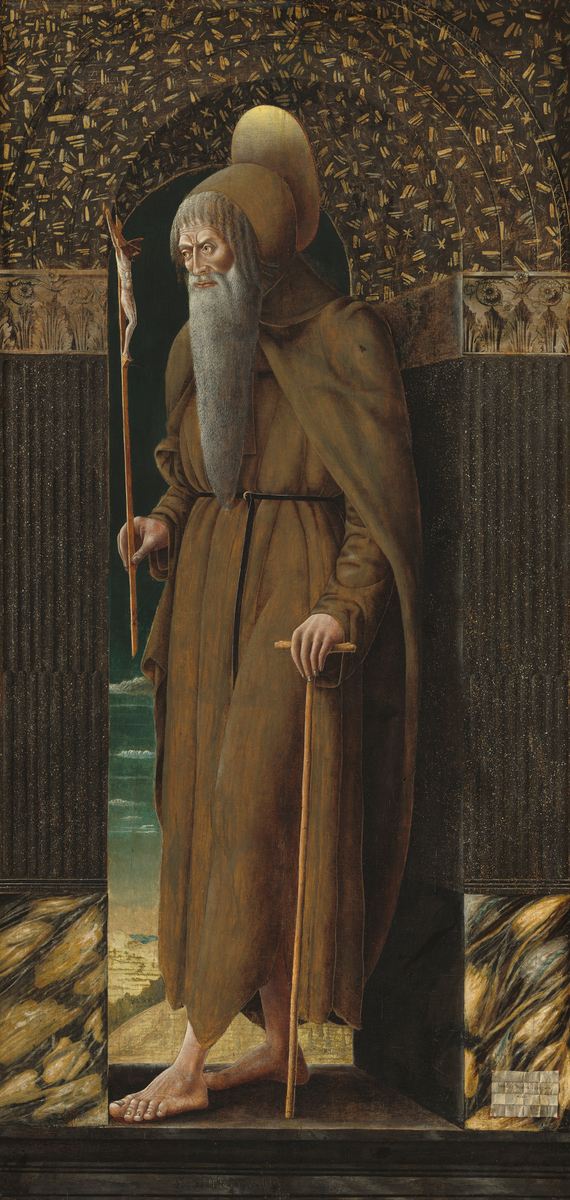
Object Information
- Creator:
- Francesco Benaglio
- Date:
- ca. 1470-1475
- Medium:
- tempera on spruce panel
- Dimensions:
- Credit:
- Samuel H. Kress Collection
- Copyright:
- © Public Domain
Provenance
Data as published online by the National Gallery of Art:
Sir Francis Baring, 1st Bt. [1740-1810], London;[1] (sale, Christie's, London, 15 March 1805, no. 51, as by Francesco di Ladi);[2] (Thomas Winstanley, Liverpool); William Roscoe [1753-1831], Liverpool, by 1813, sold before 1816.[3] Private collection, England. (sale, Robinson, Fisher & Harding, London, 27 November 1924, no. 99, as St. Francis by C. Crivelli).[4] Art market, London, by 1933.[5] (Count Alessandro Contini-Bonacossi, Florence);[6] purchased July 1948 by the Samuel H. Kress Foundation, New York;[7] gift 1952 to NGA.
[1] On this collector, see Francis Haskell, Rediscoveries in art: some aspects of taste, fashion, and collecting in England and France, Ithaca, 1976: 72.
[2] Burton Fredericksen (in The Index of paintings sold in the British Isles during the nineteenth century, 4 vols. Santa Barbara, 1988: 1:49, 295) established the painting's ownership, which is not specified in the sale catalogue, on the basis of an annotated copy of the catalogue in the files of Christie's in London.
[3] See Michael Compton, "William Roscoe and Early Collectors of Italian Primitives," Liverpool Bulletin 9 (1960-1961): 47. Hugh Macandrew (letter of 11 September 1961 to William Campbell, in NGA curatorial files) transcribes a description of the painting in Roscoe's hand from a manuscript catalogue of his collection (Roscoe Papers, Liverpool Library, 3897).
[4] Everett Fahy (his letter of 19 November 1984 in NGA curatorial files) called attention to a Cooper negative of the painting in the Frick Art Reference Library in New York; the photograph, taken on the occasion of the sale in 1924 in London, shows the painting dirty and with a check running vertically through the figure, but otherwise with an aspect not unlike the present one.
[5] According to Evelyn Sandberg-Vavalà, "Francesco Benaglio," Art in America 21 (1933): 62-63.
[6] By April 1948 (the date of Roberto Longhi's expertise, copy in NGA curatorial files), the panel must already have been with Contini-Bonacossi, for whom Longhi wrote his opinion in Italian (his expertises for the Kress Foundation are usually in English).
[7] The Kress Foundation made an offer to Contini-Bonacossi on 7 June 1948 for a group of twenty-eight paintings, including the Benaglio; the offer was accepted on 11 July 1948 (see copies of correspondence in NGA curatorial files).
Tags
* Collection Data
All collection data is based on research completed before December 2017. For details, read about the research methods of the Northbrook Provenance Project.